In 1911, two major figures in American labor history came to Big Trees Grove.
On May 30th, the grove welcomed one of the most well-known lawyers in America.
 |
Clarence Darrow, c. 1922 - Library of Congress
|
"Clarence Darrow, chief counsel for the McNamara brothers was in Santa Cruz yesterday as guests of Olaf Tvietmoe, Secretary of the State Building Trades Council. Tvietmoe met Darrow and his party at Parajo and took them on an auto trip to the big trees, where several hours were spent."
Darrow was in San Francisco that May in relation to the trial of the McNamara brothers. Darrow was hired by Samuel Gompers, president of the American Federation of Labor (AFL), to defend the brothers who were accused of bombing the Los Angeles Times. Harrison Gray Otis, the newspaper's owner, was vehemently anti-union. When the Los Angeles Iron Workers went on strike in June 1910, Otis led a media campaign against them.
On October 1, 1910, a bombing took place just outside the newspaper's building. The resulting fire ignited natural gas lines and barrels of ink stored in the area. The incident killed twenty-one people. Two members of the Iron Workers Union, brothers James and John McNamara, were arrested for the bombing. Most labor leaders, including Gompers, believed that the brothers were framed.
The trial began October 11, 1911. When it appeared that the evidence favored
the brothers’ guilt, Darrow began to negotiate a plea deal to help the McNamaras
avoid the death sentence. "During the trial, both the defense and the
prosecution allegedly engaged in the threatening of witnesses, and tampering
with evidence. The defense was accused of bribing a juror in the case, for
which Darrow stood trial following the conclusion of the McNamara case. He was
acquitted of the charges of bribery." The McNamaras pled guilty and were sent
to San Quentin with one brother receiving a light sentence and the other receiving
life. Both brothers died in 1941.
Darrow gained notoriety as a defense counsel for his work in many dramatic
criminal trials. He was also well known as a speaker and debater. Among his
famous cases was the defense of anarchists charged with murder in the Chicago Haymarket
Riot of 1886; the defense of Eugene V. Debs, president of the American Railway
Union, on a contempt charge arising from the 1894 Pullman Strike; defense in
the famous murder trial of Leopold and Loeb; and defense of World War I war protesters
charged with sedition. His defense of striking Pennsylvania coal miners
(1902-1903) helped throw light upon their horrendous working conditions and the
use of child labor. Perhaps he is most famous for his 1925 defense of a
Tennessee high school teacher accused of teaching the Darwinian theory of
evolution in violation of Tennessee State Law. Though the teacher was found
guilty in what became known as the Scopes Monkey Trail, Darrow was able to hold
up to public ridicule the fundamentalist views on the topic.
On September 6th, Big Trees Grove welcomed Samuel Gompers.
"Samuel Gompers, president of the American [F]ederation of [L]abor (AFL),
will speak at the armory in Santa Cruz on the evening of September 6 ... Mr.
Gompers’ address will be delivered at the armory under the auspices of the
local building trades council, and will be on a subject related to the cause of
organized labor."
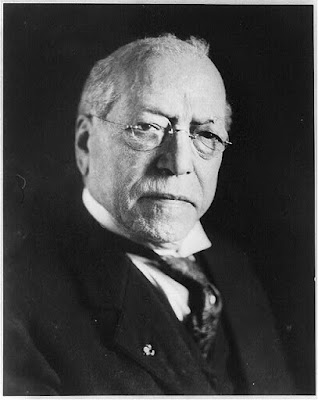 |
Samuel Gompers, c. 1920 - Library of Congress
|
British-born Samuel Gompers
immigrated to New York City in 1863. He became a naturalized citizen while practicing
his father’s trade of cigar making. In 1886 he formed the American Federation
of Labor (AFL), for which he was president until 1924. Under his leadership the
AFL became the largest and most influential labor federation in the world. Gompers
laid the foundation of the American labor movement and its successful
strategies. He advocated organizing by crafts and trades and working for better
wages, benefits, work hours and conditions through collective bargaining.
As with Darrow before him, Gompers was also invited to Santa Cruz
through the efforts of Olaf Tveitmoe, Secretary of the State Building Trades Council. The Santa
Cruz labor community was quite honored by the visit since the only other
California cities visited by the famed labor leader were Oakland, Los Angeles,
San Jose and San Francisco.
The Santa Cruz Evening News noted that "Mr. Gompers will be given
an automobile drive to the Big Trees, along the cliff drive, and to other
points of interest in and about Santa Cruz."
Sources: “McNamara Brothers - The Los Angeles
Times Bombing,” The James B. and John J. McNamara Papers 1905-1961 Collection
- US-80-9, Online Exhibit by
Eira Tansey, University of Cincinnati Libraries Digital Collections &
Repositories, https://digital.libraries.uc.edu/exhibits/arb/mcnamara/bio.php; “Darrow and
Tveitmoe Visit the Big Trees,” San Jose Mercury-News, June 2, 1911; “Samuel
Gompers is to Reach San Jose Today,” San Jose Mercury-News, September 5,
1911; “Gompers to Speak in Santa Cruz,” Santa Cruz Evening News, 24 Aug 1911; Encyclopedia Britannica, “Clarence Darrow, American
Lawyer,” Revised by Katheleen Sheetz, 2020. https://www.britannica.com/biography/Clarence-Darrow
and “Samuel Gompers, American Labour Leader,” revised by
Michael Ray, 2020, https://www.britannica.com/biography/Samuel-Gompers.


