 |
James Lynch, President of the International Typographical Union - The American Guardian, July 25, 1930
|
"Under the big trees of the
Felton grove the outing of the officers of the International Typographical
Union reached its fitting climax this noon, when one of the giant redwoods was
duly dedicated to James M. Lynch, president of the union. The ceremony was
celebrated with all the honors."
On August 12, 1911 officers
of the International Typographical Union, accompanied by members of the San
Francisco Newspaper Publishers’ Association traveled by train from Santa Cruz
to Big Trees Grove. Upon arrival local entrepreneur Fred Swanton hosted a
barbecue dinner. Following the dinner President Lynch was escorted to his tree
where George A. Tracy, first vice president of the union, made a "presentation
speech, in which he declared that the tree was as straight and lofty as Jim
Lynch."
Lynch, a New York native, began his career as a labor
organizer by fighting for a standard wage scale for all
printers. In 1901 he became president of the International Typographical Union,
one of the nation’s oldest trade unions and one of the first unions to admit
female members. As President of the Typographical Union in 1906, Lynch
initiated strikes in many major cities in an attempt to secure an eight-hour workday.
Lynch resigned in 1914 to become the New York State Commissioner of Labor. He later worked as a
member of New York Governor Franklin D. Roosevelt’s commission to investigate
the subject of old age security, resulting in passage of a 1929 old age New
York State security law.
"In accepting the honor paid by the publishers, President Lynch said he hoped the tree would be typical in its life, growth and strength of age, vigor and usefulness of the International Typographical Union."
One account of the event gave the general location of the new James Lynch Tree by stating that "[i]n the forest are trees named for famous warriors, statesmen, and others, both living and dead, and it was a happy thought that caused one of the finest redwoods, towering to a height of 300 feet, and named after the head of the greatest trade union in the world."
Mention of the approximate location of this tree lends some credence to a 1916 article in the Santa Cruz Evening News entitled, "Our Much-Dedicated Big Trees". The author said that Lynch "... was so impressed with the honor of having this particular tree named after him that he caused a bronze plaque to be sent from the East chronicling the event. A committee came down from San Francisco under big expense to place the Lynch plaque on the tree." The account further stated that the plaque was not allowed to be attached to the tree "... for fear it might split the tree --- spoil its growth and spoil its dedication to the next celebrity that came along."
The article pointed out that the grove contained scarcely
one tree "… but that can show a list of titles as long as the baptismal name of
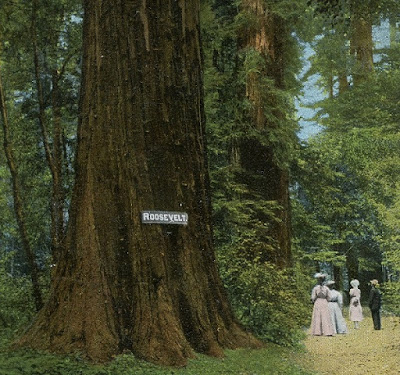
a prince of the blood royal." The tree named for Lynch was supposedly the same
tree once dedicated to President Theodore Roosevelt (back in 1903) which was located not too far from Ingersoll's Cathedral.* According to the article, the Roosevelt Tree was reused
many times for other celebrity tree dedications including ones for "… Jim Jeffries,
Andrew Carnegie, George G. Radcliff, Jack Johnson, Hiram W. Johnson, Warren
Porter, William J. Bryan, [and] William Randolph Hearst … We think the Japanese
statesmen who came down with C.C. Moore and Mr. Torchiana [from the 1915 Panama-Pacific Exposition] were similarly
honored, but we forget their names."
 |
Author's Personal Collection
|
This 1916 article is the only one located to date
which claims that the Roosevelt Tree was used in this manner. If this practice
is true, and judging by the names of the celebrities mentioned, it appears to
have occurred during the period when the grove was under the direct management of
the Welch brothers after 1900.
* One story suggests that Ingersoll's Cathedral may have been given the name Cathedral Spires by Robert Ingersoll during his visit to Big Trees Grove in 1884.
Sources: “San Francisco Publishers As Hosts,” The
Typographical Journal, Volume XXXIX, No. 3, September 1911; “Our
Much-Dedicated Big Trees,” Santa Cruz Evening News, February 3, 1916; “Dedicate A Big Tree to Lynch,” San Francisco Chronicle, August 12, 1911;
“Former Chief of I.T.U. Dies,” San
Pedro News Pilot, July 16,
1930.


